

Does Anyone Make Money On Limited Edition Makeup
Beauty Pt 6: Rooting for Resale
This is the final installment in a 6 part serial, picking apart the dazzler industry; from the macro market place trends to the concern models to watch.
In this final installment, I wanted to tackle the most disruptive idea I came beyond- Beauty Resale.
And then far there are no startups offering this as a business in the U.k. beauty industry, simply as a broader trend, resale is massive. In that location are likewise early signals of existing marketplaces expanding into beauty resale, in the Us and in Nippon, and I believe these are worth unpicking and watching closely. I think we may be at the start of a new wave of consumer beliefs and an increasing readiness to purchase second-hand.
In this post, we'll await first at the broader trend, then unpick those early on signals, before diving into some of the challenges however to exist resolved for this to become mainstream.
Let's dive in.
The wider resale trend
In resale, there are four main value propositions:
- Notice a bargain and pay less— buyer
- Waste product less and lower your eco impact — buyer
- Find express edition or collector's items that are no longer available to buy direct — buyer/collector
- Brand coin from unused items — seller
- Make a profit on limited edition items — seller/collector
The resale model picks up on a number of trends, including sustainability, and affordable luxury trends- and is also stoked by the growing number of ltd edition drops and celeb/influencer collections.
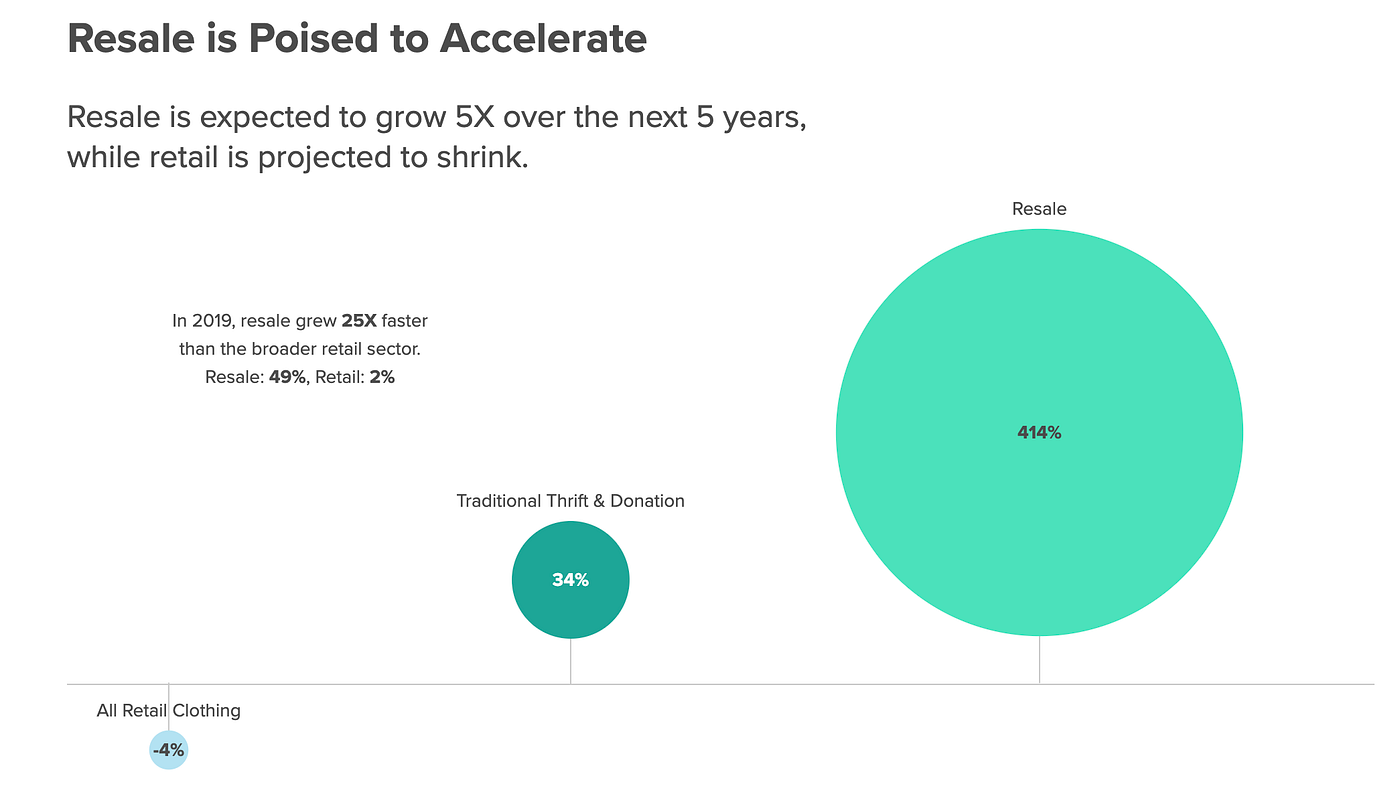
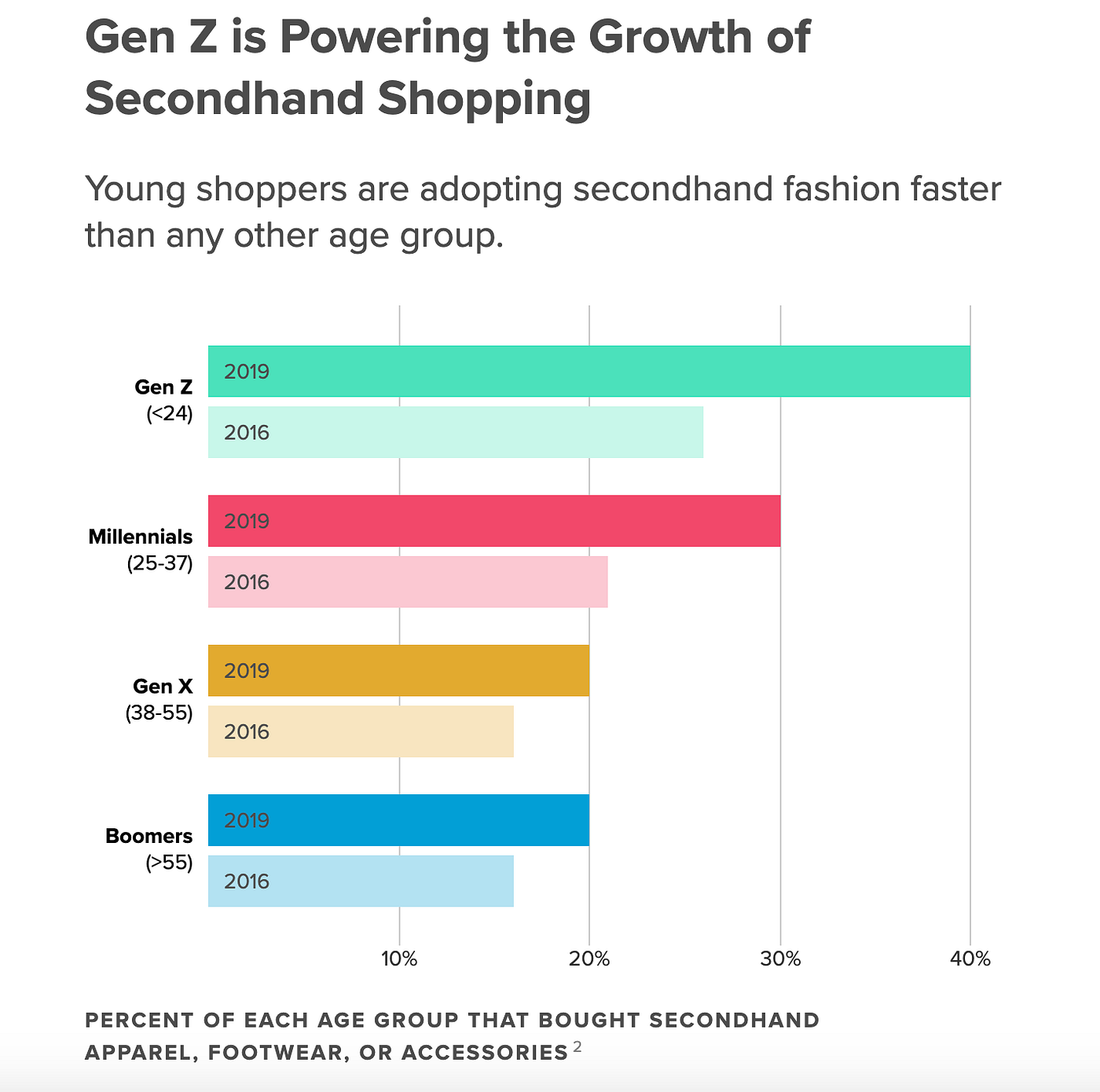
No wonder then that it's growing fast. The Secondhand Market place is fix to hitting $64B in the Next 5 Years. Past 2029, it will exist 2x the size of fast fashion. It'southward being further accelerated past the rising consumer ability of more environmentally conscious Gen Z and Millenials, who are adopting second-hand fashion two.5x faster than other groups, in function because they've shed any stigma attached with buying used/second-hand products.
What'southward likewise telling is that resale behaviour isn't an reconsideration when you lot do a leap clean or Marie Kondo your wardrobe. In 2019, xl% of consumers were thinking nearly the resale value of items they bought first hand.
And, as we must these days, when we add Covid into the mix, the case for resale only strengthens.Enquiry shows that economic doubtfulness is ane of the master drivers for consumers making the leap to second-manus shopping and nosotros know that Covid-19 will pb recessions and a subsequent tightening on household spending.
Meanwhile, increasing time at home and financial pressures combine to increment supply, as shoppers have more time to clear out, and effort to resell what they may otherwise accept wasted or donated.

So which startups are already well placed to capitalise on these trends?
Fashion Resale Startups to Spotter
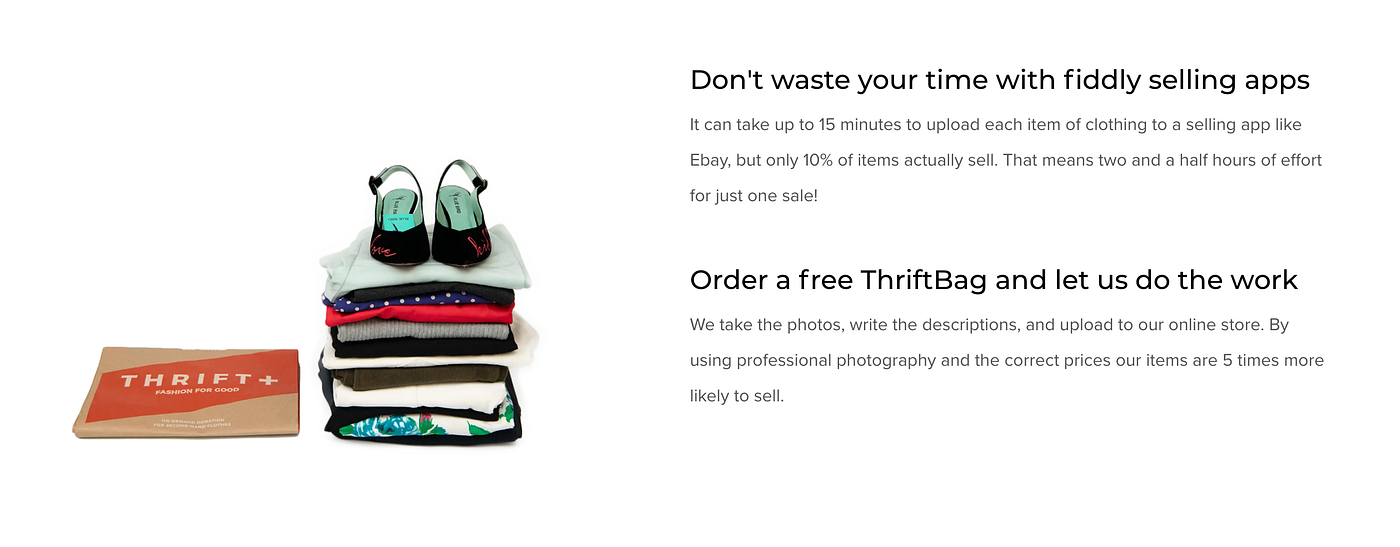
oneAusterity+: Startups like Thrift take worked hard to make the seller experience fifty-fifty simpler. Lowering the barriers to donate and clear apparel, they send recyclable newspaper bags for y'all to pack at habitation, and fifty-fifty adjust pickup from your place. They've cleverly combined the donation and resale propositions, so all sales through their platform see a 3-manner revenue split, bringing customers coin and the feel good gene. Thrift+ manage the sale and logistics for which they practise accept a cut. The seller and so gets Thrift+ credits to purchase more on the market (creating a squeamish trivial circular economy) and they can likewise choose their favourite charity to accept the final cut.
Information technology takes all of the hassle and guilt out of the equation when yous come to buy your adjacent slice. Founded in 2017, they've raised £ane.5m and then far, £950,000 of which was closed in Apr 2020.
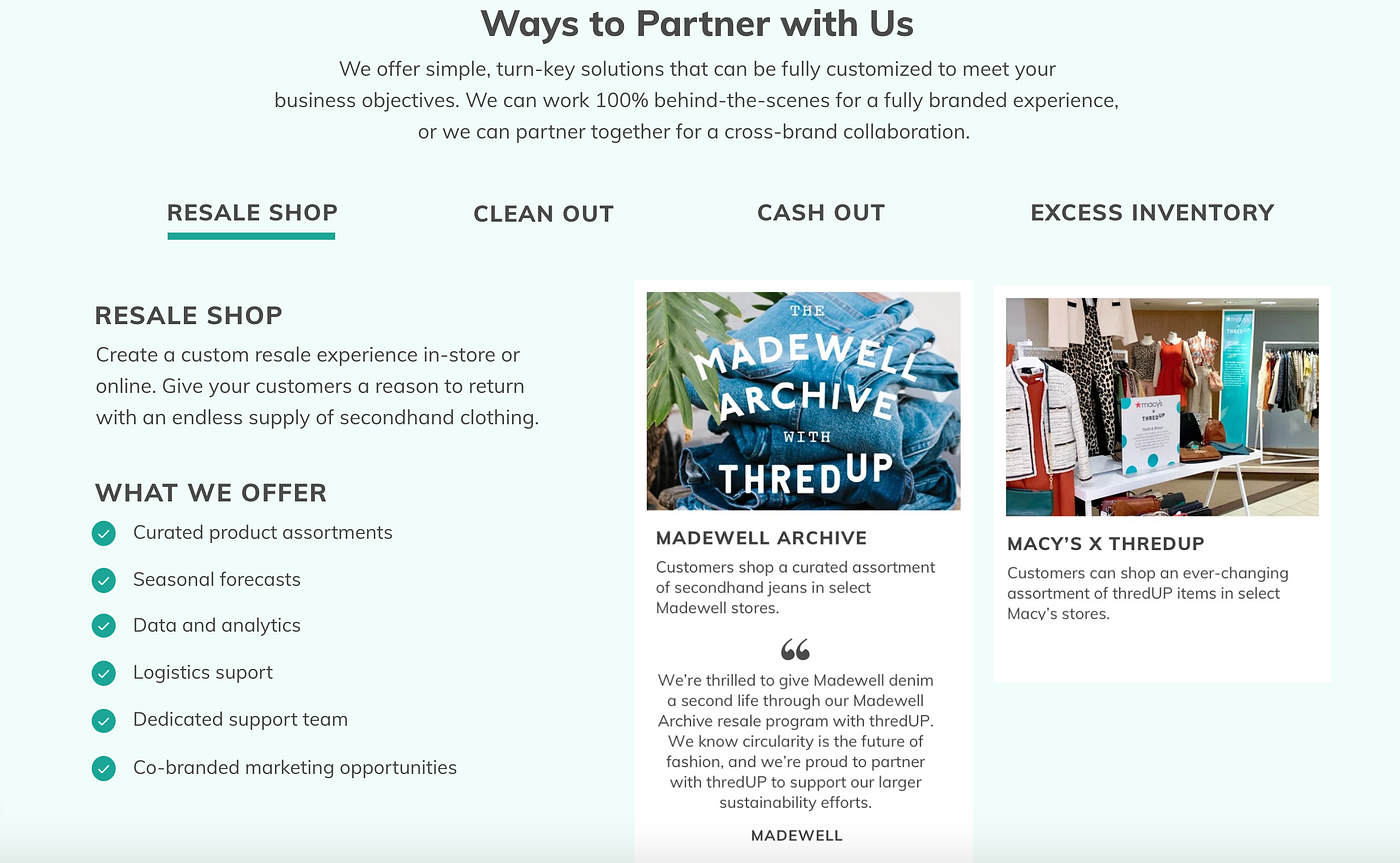
two ThredUp: Founded in 2009, and valued at $990m in 2019, with £223.3m raised to appointment. They started every bit a second-hand marketplace for consumers. Even before Covid, they were growing fast. In the commencement 6 months of 2019, they had 578,000 app downloads, upward 71% from the same time flow in 2018, and were reaching around 19,000 users daily. In 2019, they too added Resale every bit a service, partnering with some of the large label brands on their site. For the brands, information technology's a chance to sell excess inventory, appoint the client with an environmentally friendly in-store pop-upwards (one time stores reopen), and have a piece of the growing resale pie. For ThredUp, it's a key competitive advantage against players like Poshmark or TheRealReal. To serve this marketplace, they raised additional capital to build a new distribution center with the capacity to process 50 million unique items per year.
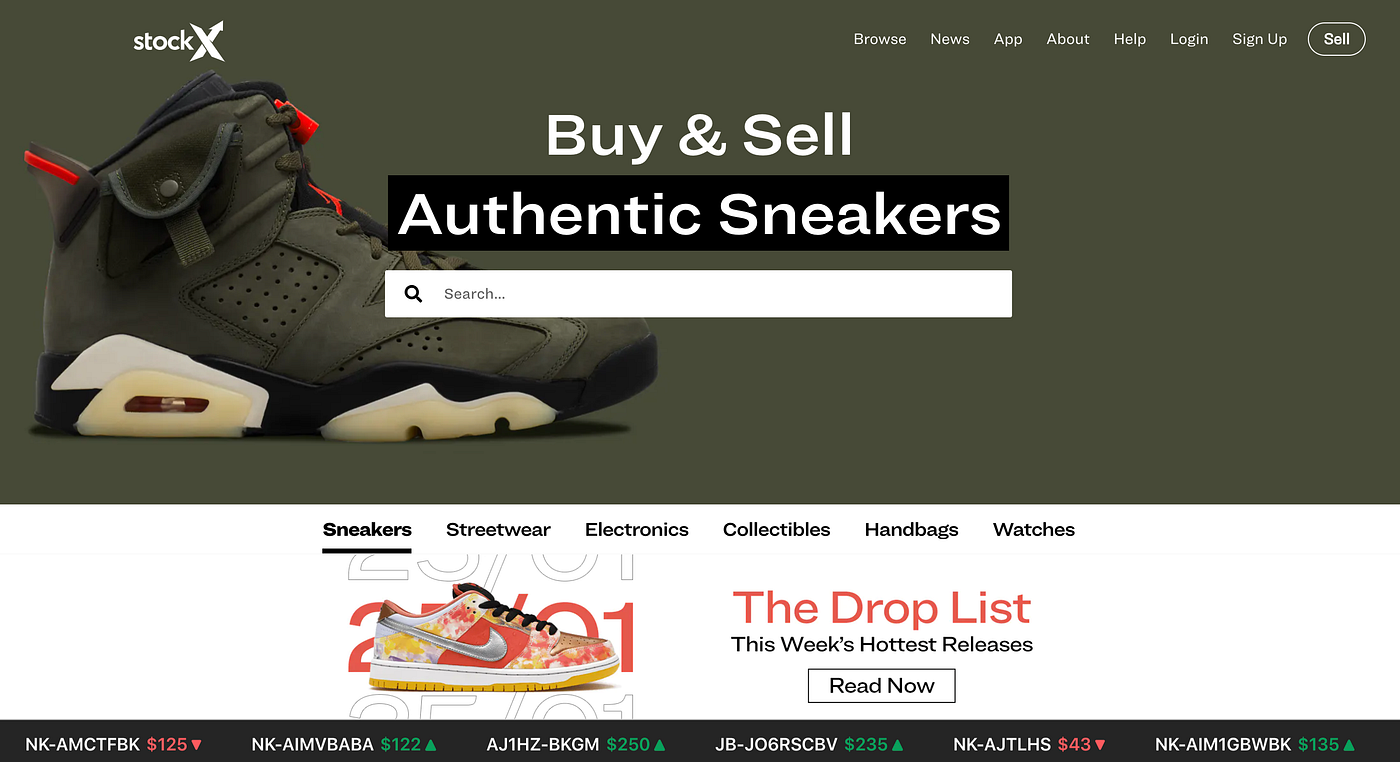
3 StockX started as a sneaker resale platform targeting collectors. Today, they want to exist the "stock marketplace of things". Valued at $two.8bn after their last fundraise of $275m in December 2020. Their value proposition revolves around delivering "accurate" sneakers which are hard to pick up showtime hand during product drops. To evangelize this, they created their own 90-day authentication programme to train employees. Earlier, there was no authentication guide for sneakers- then StockX bought real and faux pairs and created their own manuals documenting the differences, creating different difficulty levels depending on how "high terminate" and varied the number of fakes for a pair of shoes are. They now employ 100+ authenticators in six locations (incl London, Netherlands, and Us). This lets buyers pick upward a pair with confidence, while sellers can maximise on price.
They've streamlined the selling experience every bit they take a catalogue of pictures and product details for all the models they cover, cutting fourth dimension spent writing descriptions and taking nifty pics, and minimising sales lost to poor post pattern. They've also expanded to include streetwear, handbags, collectibles, jewellery, and watches and take even partnered with brands like Addidas to create new production drops of limited collections exclusively on the site.
Their ultimate goal is for brands to release products directly onto StockX to let products to find their true price. This is a proposition that works particularly well with express-edition sneakers, which often have a higher resale value than theoriginal retail price.
For more than deep insights into consumer resale behaviours, I highly recommend the full Thredup reports. Yous tin detect their latest hither or in the links higher up.
Beauty resale — early signals
As mentioned, there are far fewer startups who have focussed on dazzler as their entry into the resale space. However, there are a few examples of the trend extending into this space.
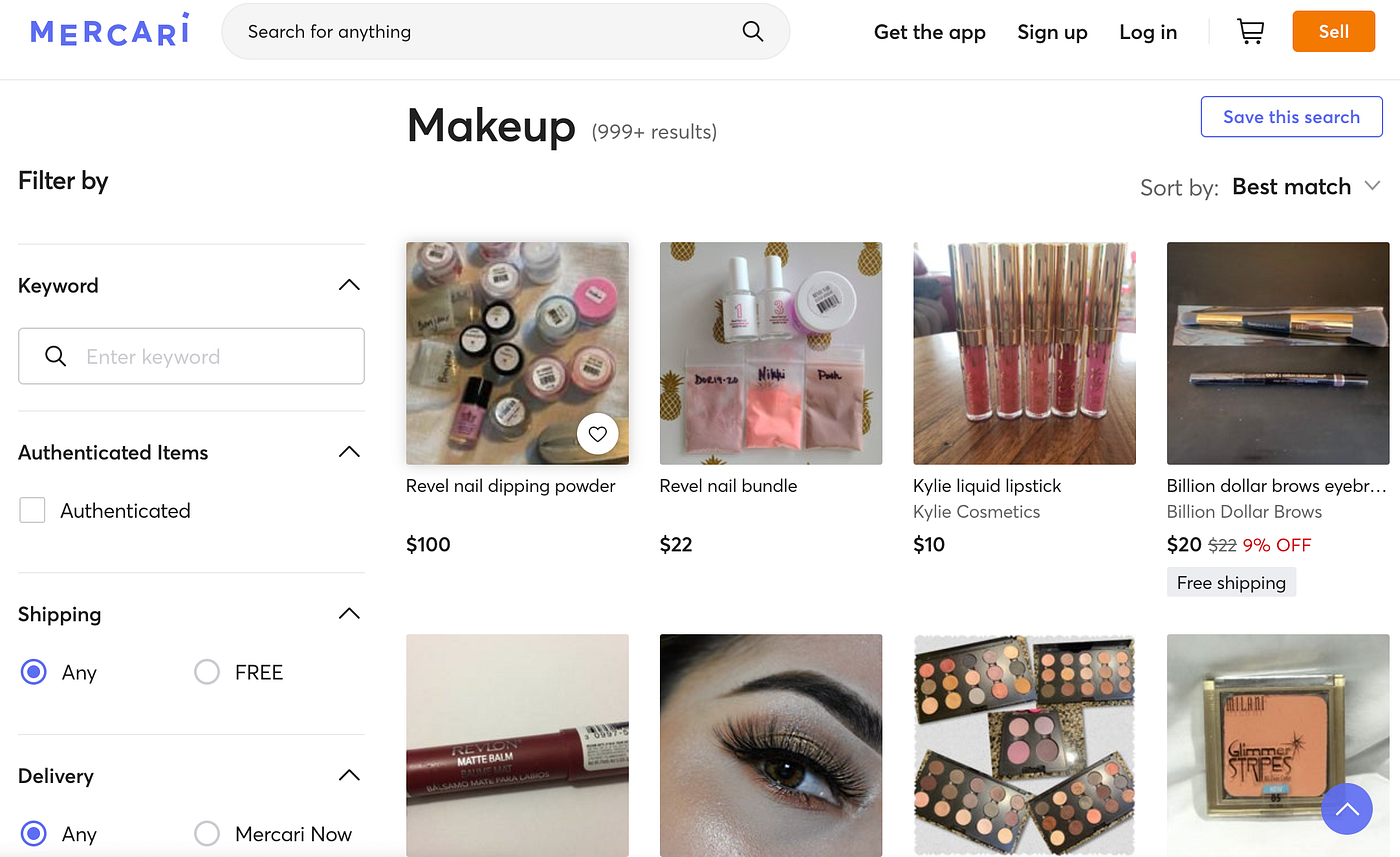
aneMercari. A Japanese marketplace that went public in 2018 at a valuation of $one.2bn. Like The RealReal and StockX, they do have an authentication service, but this doesn't currently extend to their beauty ranges. However, a quick search for not-authenticated 2d-mitt products brings up hundreds of pre-endemic Chanel blushes, NARS lipsticks, and Estee Lauder skincare items, some with discounts of upward to 50%. It'south particularly popular for giving access to brands yous tin can't buy in Japan.
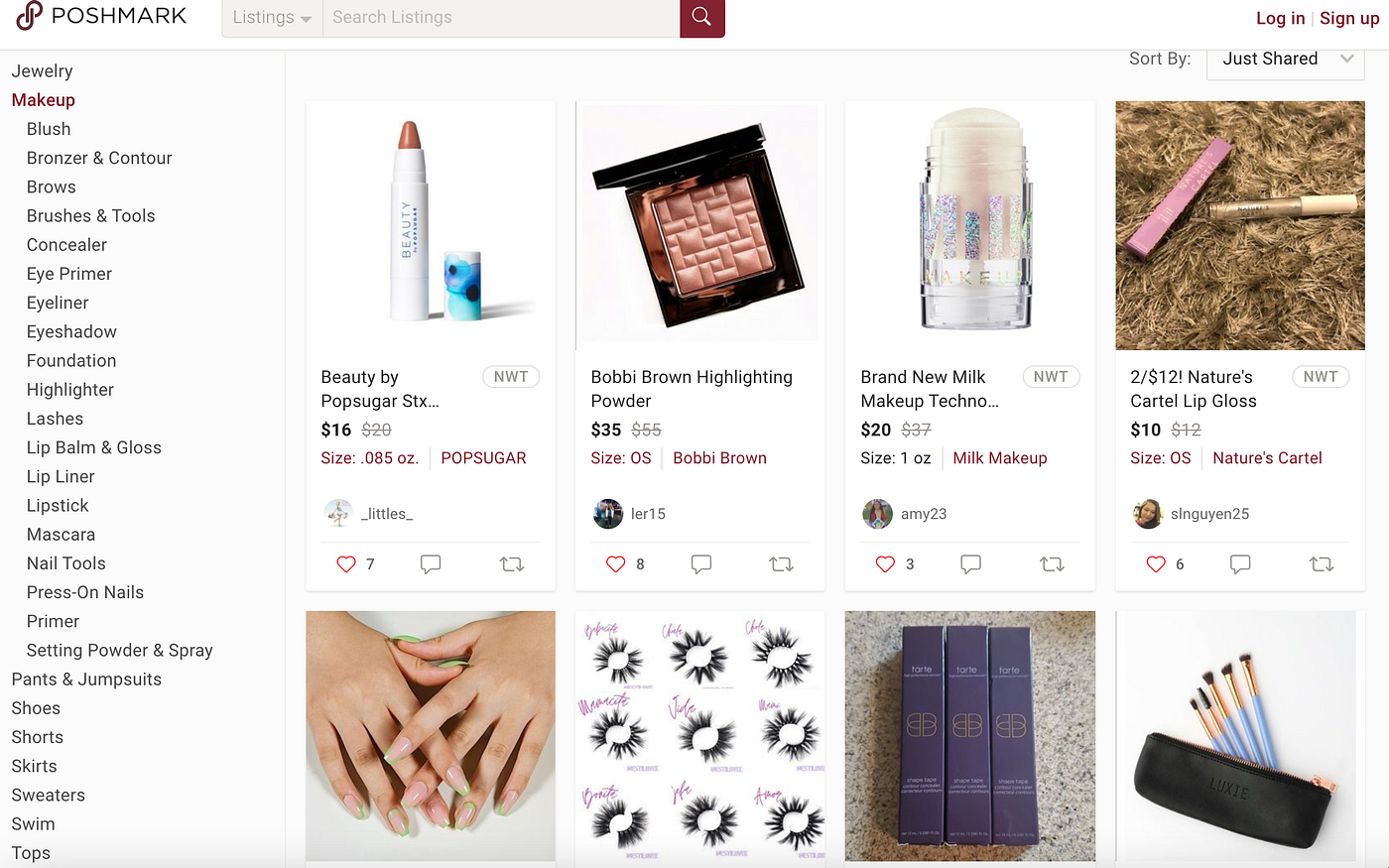
2 Poshmark. Another peer-to-peer platform, this time, based in America. They added makeup officially in 2019 and expanded their beauty proposition in 2020. They IPO'd in January 2021 at a valuation of $3bn. Like Mercari, they don't do whatever authentication, yet dissimilar Mercari, they don't 'allow' the auction of used makeup. Ebay accept the same policy, though it's hard to enforce. As is ensuring products are inside their expiration dates. Poshmark accept include a 'Written report' button on every listing, so if users practice come up across a used makeup production, they're asked to written report it, but that's not a peachy user experience to build trust.
iii Glambot. A member of the 2015 500 Startups cohort. You tin can find their original pitch deck hither. When they left the accelerator they were doing over $1M in annual revenue run rate, growing thirty% month over calendar month and enjoying lx% gross margins, though more up to date numbers are harder to find and their user interface doesn't feel like its seen much of an update in the last six years.
Glambot run a dissimilar model to Poshmark and Mercari, more than akin to a consignment resale platform like The RealReal. They purchase barely-used make-upwards, and then employ a stringent cleaning routine, before selling on for a profit. Every piece comes with a sticker to reassure the customers it has been inspected and cleaned by a lab fellow member. However, and so far, information technology's non a model open to everyone on the seller side. Sell packages must contain at least fifteen full-size, qualifying items; international packages must comprise 30. This suggests their biggest client segment is likely to exist the influencer or brand administrator receiving more freebies they can apply, as opposed to the casual customer who managed to selection upward an extra Kylie Jenner lipstick in the latest express edition drib. Like StockX, they only accept certain brands which they can authenticate. So far, they also don't accept pilus products, body products, nail products or retail sized fragrances, likely considering they nonetheless need to build out authentication and sanitization guides for these products. They're too geographically focussed on the The states; currently, only offer free shipping for sellers there, making the model less feasible for international sellers.
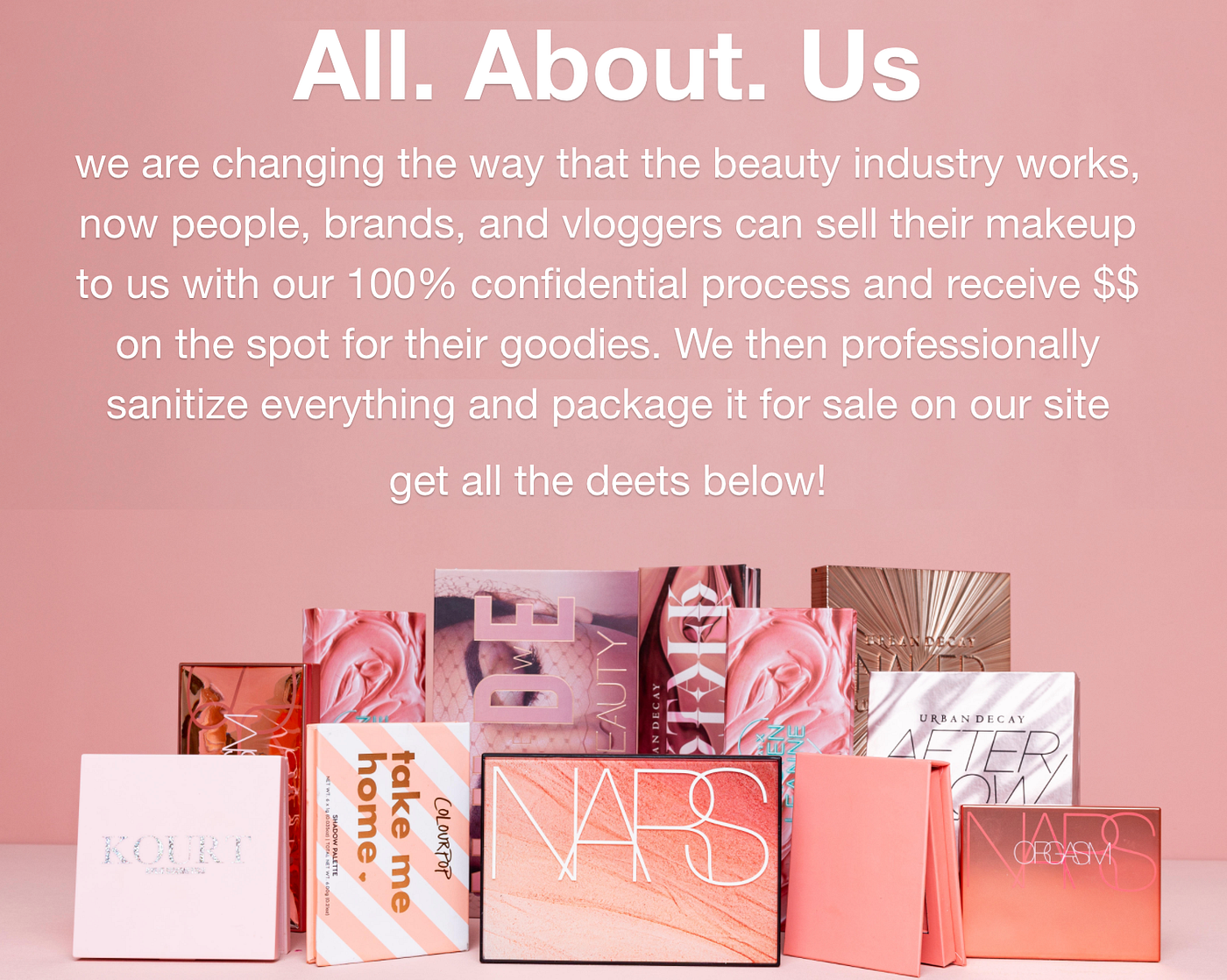
4 Requite and Makeup. A charitable project founded in 2010 by Caroline Hiron to bring unused and lightly used toiletries to women's refuges. They don't take items that accept been tested with an applicator, or are beyond their sellby, and ask donors to call back "Would you donate this to a friend". They also don't practise additional sanitation themselves, but do rehome lightly used products to those who demand them most. They've partnered with Glossy Box which is a smashing style for the subscription box make to help people rehome the products they use least in each box and feel good virtually it; somewhat of a sticking plaster on the sustainability issues thrown upward past dazzler subscription boxes, only a smashing initiative none the less to reduce waste and have some existent bear upon. For similar initiatives, see Projection Dazzler Share and Share your Beauty though some of these initiatives are struggling during Covid.

Beauty resale activity is besides already happening on sites like Depop, and Ebay too, but information technology'southward largely unpoliced and unregulated and is not the focus for either market place in terms of growth.
The Challenges
There are some large challenges notwithstanding to be solved for beauty resale to go mainstream.
- Authentication: is at that place a style to authenticate makeup in a StockX fashion model? Peculiarly for limited edition product drops? This could exist for a limited number of Cult brands, simply is challenging in the dazzler industry which is incredibly fragmented, with new brands launching and reaching cult status relatively apace; compared to a more consolidated sneaker market. Potentially though, this be an unfair advantage for a company who already own multiple brands similar LVMH and may be best placed to lead the way on IP to authenticate true products.
- Hygiene: Makeup and beauty products pose a lot more challenges in this regard than apparel, furniture or shoes. How practice you lot know if used makeup beingness contaminated, or tin can someone create a model to de-contaminate cost-effectively?
- Expiration dates: some other unique claiming in the dazzler market. Products do elapse. Can resale platforms really police this aspect? Or will the market be happy to self-law? The challenge here is if you don't track when a product was bought and opened, it can be genuinely hard to know whether your mascara has months or days left earlier it becomes less usable or potentially unsanitary.
- Edifice consumer trust in second mitt beauty: in large office, this volition exist achieved by solving for the above, but I would debate there is however a behavioural shift before virtually consumers will be happy purchasing dazzler second-hand. Increasing comfort buying other products second mitt volition definitely support this cause though.
Packaging innovation may help make the hygiene claiming easier, for case dispensers which give you the perfect corporeality of product each day also arrive harder to affect/infect the contents, and even harder to tamper without evidence. Nevertheless, unless a large corporate owns the resale platform, they're unlikely to design for piece of cake resale. It's more probable these kind of innovations happen to improve the customer feel, and as an unintended outcome, benefit the secondary marketplace.
Spotter this Infinite
Certainly a space to lookout man, I believe information technology's a motion that will come to the industry, information technology's merely a affair of when.
In fact, now may exist the time for dazzler corporations to begin experimenting with the model. If I were a large corporate in the primary market, I'd certainly want to explore how to stake a claim to the secondary i before the unicorn startups beginning to emerge and own the marketplace. I'm sure Nike or Ebay would beloved to own StockX, but they may non desire to pay to acquire, based on its $2.8bn valuation today.
— —
I hope you've enjoyed this 6 part deep dive into the dazzler industry. Allow me know which industries you lot'd similar to see unpicked next, or the other models you lot're watching!
In the meantime, if you're curious to run across what other trends and business concern models we uncover, yous can bring together our studio newsletter to stay in the loop with new venture opportunities and market trends on Substack.

Does Anyone Make Money On Limited Edition Makeup,
Source: https://medium.com/venturing-with-vantage/beauty-pt-6-rooting-for-resale-98a5d6d795b4
Posted by: winfreyplarome.blogspot.com
0 Response to "Does Anyone Make Money On Limited Edition Makeup"
Post a Comment